|
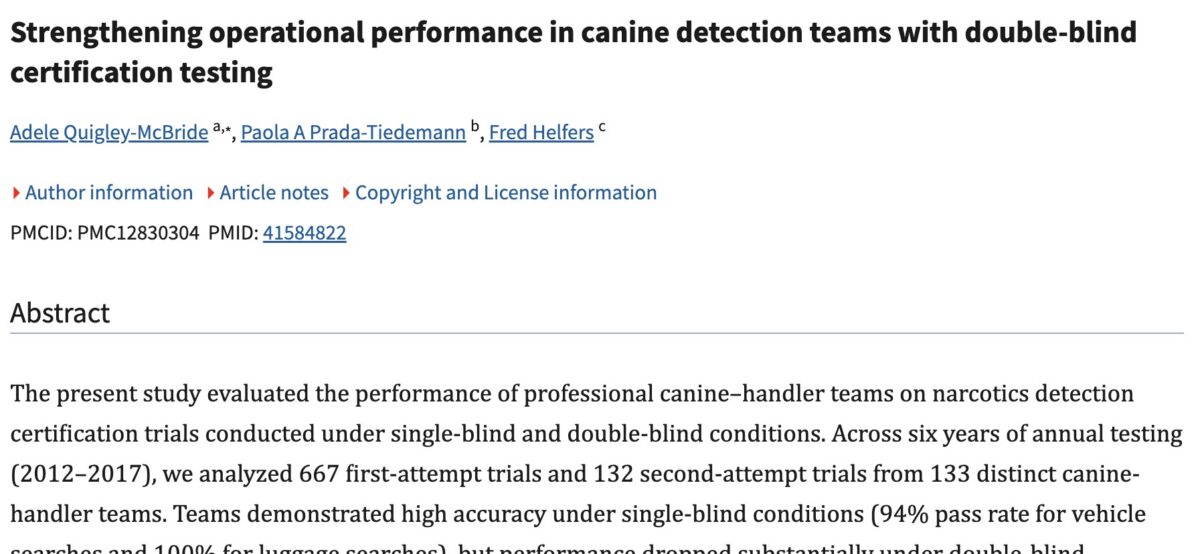
How much of our search performance comes from the canine’s training, and how much might be influenced by the people around the team? A recent paper by Adele Quigley-McBride, Paola Prada-Tiedemann and Fred Helfers, Strengthening operational performance in canine detection teams with double-blind certification testing, explores this important question.
I have worked with Adele Quigley-McBride on several projects, and I strongly support her approach to the human side of the canine team. We spend considerable time developing the dog’s skills, but our expectations, decisions and interpretation of behavior deserve just as much attention.
The researchers examined six years of narcotics certification records involving 133 canine–handler teams. Across first attempts, the overall pass rate was 94% under single-blind conditions and 72% under double-blind conditions. In double-blind searches, neither the handler nor anyone administering the search knew the target locations or number. These figures represent complete search passes, rather than individual target detection rates. Read the paper.
For me, the practical value is clear: we need opportunities to assess how we work when the answers are genuinely unknown. Can we recognize our canine’s trained response, maintain an effective search and confidently finish when nothing is present?
There are limitations. Vehicle searches were always double-blind and residence searches always single-blind, so search difficulty and blinding were partly intertwined. Luggage searches offered a useful comparison, with pass rates falling from 100% under single-blind administration to 88% under double-blind administration, although these occurred in different years. The study also did not directly test whether adding double-blind training causes improvement.
My takeaway is to make double-blind exercises a regular, constructive part of team development once foundational skills are established. Record decisions before revealing placements, include blank searches and use video to review both ends of the lead.
The purpose is to identify what needs work and build confidence grounded in evidence. The human half of the team needs training too. |