Chiron K9 Chiron K9
Success Through Innovation
The Chiron Briefing

Greetings ,

Welcome to the September's Issue of The Chiron Briefing

September promises to be a busy and exciting month for Chiron K9. I’ll be spending the entire month in Australia, traveling to Tasmania, Sydney, Brisbane, Adelaide and Perth to deliver workshops across a range of detection disciplines. I’m looking forward to meeting handlers throughout the country, sharing knowledge and working with teams in such varied environments.

Meanwhile, Christina will be holding the fort at home. Alongside continuing our research and agricultural detection projects, she’ll be training a human remains detection canine for a local sheriff’s office.

Our Skool community also continues to grow. We’re holding regular live Q&A calls for Premium members, while continually adding new educational content and resources. It’s wonderful to see members connecting, asking thoughtful questions and developing their knowledge together.

There is plenty happening on both sides of the world, and we look forward to sharing the information with you in this edition of The Chiron Briefing.

For now, I hope you enjoy this month’s updates from Chiron K9.

-Paul Bunker and the Chiron K9 team

Training Tip

Don't Train Context; Train Odor

bin

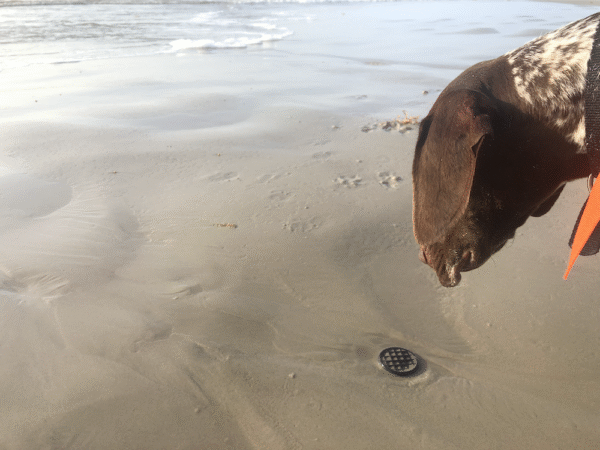
One of the challenges in detection training is ensuring that the canine is truly responding to the target odor rather than to the context in which that odor has repeatedly been presented. Without realizing it, we can create a training picture in which the container, equipment, location or placement of the source becomes just as meaningful to the dog as the odor itself. The canine may appear to be working successfully, but its behavior may actually be controlled by a collection of contextual cues rather than solely by the target odor.

Consider how target odor is presented during training. It may regularly be placed inside a Mason jar, TADD, suet cage or another familiar container. If we repeatedly use the same equipment, the canine can learn that the sight of that container, its position within the search area or even the handler’s behavior around it predicts reinforcement. The container effectively becomes part of the target picture. When the target odor is later presented without that familiar equipment, the canine may fail to recognize its significance or may show a much weaker response.

The opposite problem can occur when a familiar target-associated container is used to hold a distractor odor. For example, imagine placing hog meat inside a suet cage and hanging it from a tree during Human Remains Detection Dog training. If suet cages hanging from trees have consistently contained the target odor, the canine may respond to the setup even though the source is a non-target distractor. The dog is not necessarily making an odor-based decision. Instead, it may have learned that this particular visual and environmental picture is where a response is expected.

This is why variation must be deliberately built into a detection program. Target odor should be presented in different containers, at different heights and depths, and in a wide range of indoor and outdoor environments. It should also be presented independently of the training equipment the canine regularly encounters. Familiar containers should sometimes be blank or contain appropriate distractor odors, while the target should occasionally be placed in a completely unfamiliar presentation system. Negative searches are equally important because they teach the canine that the presence of familiar equipment does not automatically mean the target is available.

These exercises must be introduced thoughtfully. The objective is not to confuse the canine or create “trick” searches, but to identify which stimulus is actually controlling the trained response. If performance deteriorates when the usual container or setup is removed, that gives us valuable information. It suggests that the behavior may not yet be under sufficiently strong odor control and that the training program needs greater variety.

Ultimately, the target odor itself must be the trigger for the canine’s trained response—not the Mason jar, suet cage, or spice tin. 

Equipment Review

Starmark Ball

Codex Image Aug 31, 2026, 03_15_01 PM

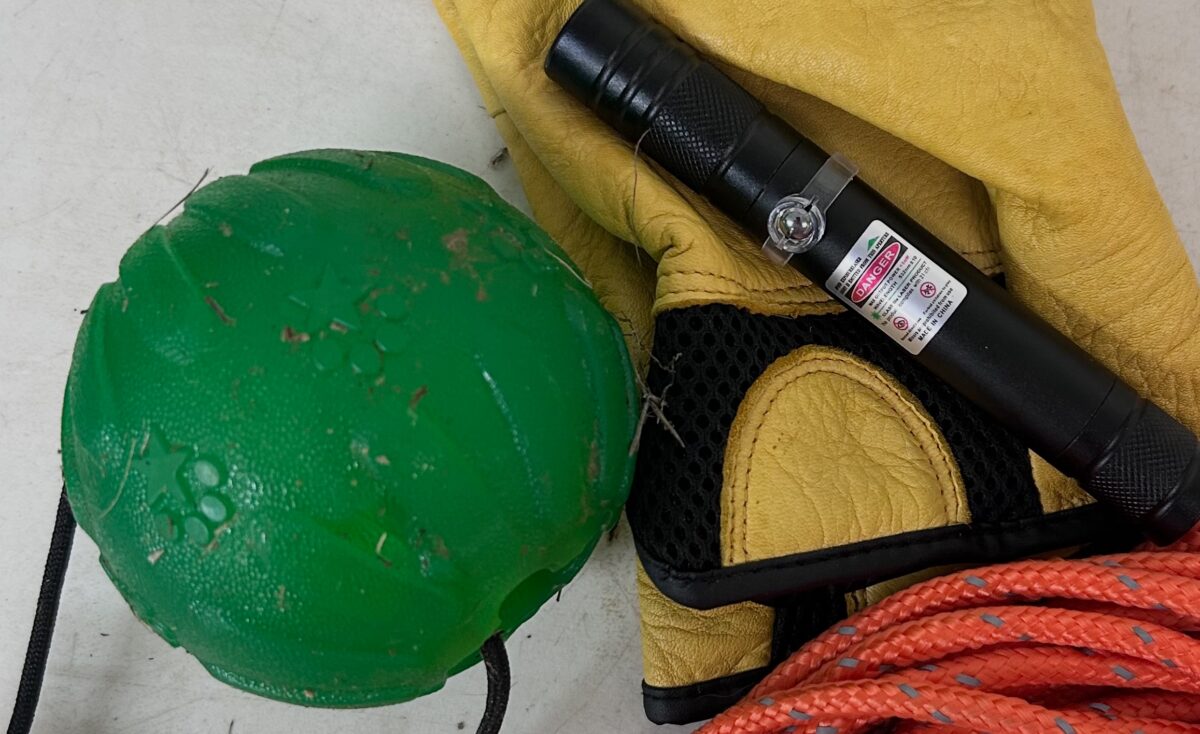
Every so often, a piece of equipment catches my attention because of the response it produces from the dogs rather than because of how it has been marketed. The Starmark Treat Dispensing Chew Ball is one of those products.

I first encountered the Starmark ball while working as an instructor at K9 European Camp. Tom and Tatiana were using it during laser-guidance training, and I was immediately interested in the enthusiasm it generated. The dogs appeared highly motivated to obtain and interact with it, making it an effective reward during a demanding training task.

Since then, I have introduced Starmark balls into our own training program and have used them regularly as rewards. Their value has become particularly apparent during our reward-selection assessments. In these assessments, we give each canine the opportunity to choose between different toys rather than assuming that we already know what the individual will find most reinforcing. Time and again, we have seen more canines select the Starmark ball than any of the other toys offered.

This is an important observation because reinforcement is defined by the learner. We may have a favorite tug, ball or food reward, but its appearance or cost does not determine its value to the dog. If the canine consistently chooses a different item and works with greater intensity to obtain it, that choice provides useful information about what is genuinely reinforcing for that individual.

The Starmark ball has several qualities that may contribute to its popularity. It is soft enough to be comfortable in the dog’s mouth while also being designed for durability. Its shape, texture and movement make it enjoyable to chase, retrieve, carry and possess. It can therefore support several styles of reward interaction rather than limiting the handler to one type of play.

Although marketed as a treat-dispensing chew ball, we primarily value it as an interactive training reward. It can be thrown for retrieval, exchanged between handler and dog or incorporated into a structured reward event following successful detection work. Food or kibble can also be placed inside it, creating another way for the canine to engage with the toy. Starmark states that the ball is made without latex, vinyl or phthalates and is available in three sizes for different dogs.

As with any reward, the way the ball is used matters. Simply handing it to the dog does not automatically create the most effective reinforcement experience. The handler should bring energy and interaction to the reward while also considering what the individual dog enjoys. Some dogs want to chase it, some want to carry it and others value possession or a game of exchange. Observing those preferences allows us to make the reward more meaningful.

No toy is suitable for every canine, and even a durable product should be inspected regularly. Starmark advises supervising dogs during use because no chew product is completely indestructible. Choosing the correct size is also important, particularly for powerful dogs or those inclined to swallow objects.

The Starmark ball has earned a permanent place in our training equipment because the dogs themselves continue to demonstrate its value. If you are reviewing your canine’s reward system, it is well worth including one in a structured reward-selection assessment. Rather than deciding in advance that it will be your dog’s favorite, offer it alongside several other appropriate rewards and allow the canine to tell you.

After all, the best reward is not the one the handler likes most—it is the one the canine is most motivated to earn.

Notes from the Field
scent class

Do Not Solve Training Problems for Your Canine

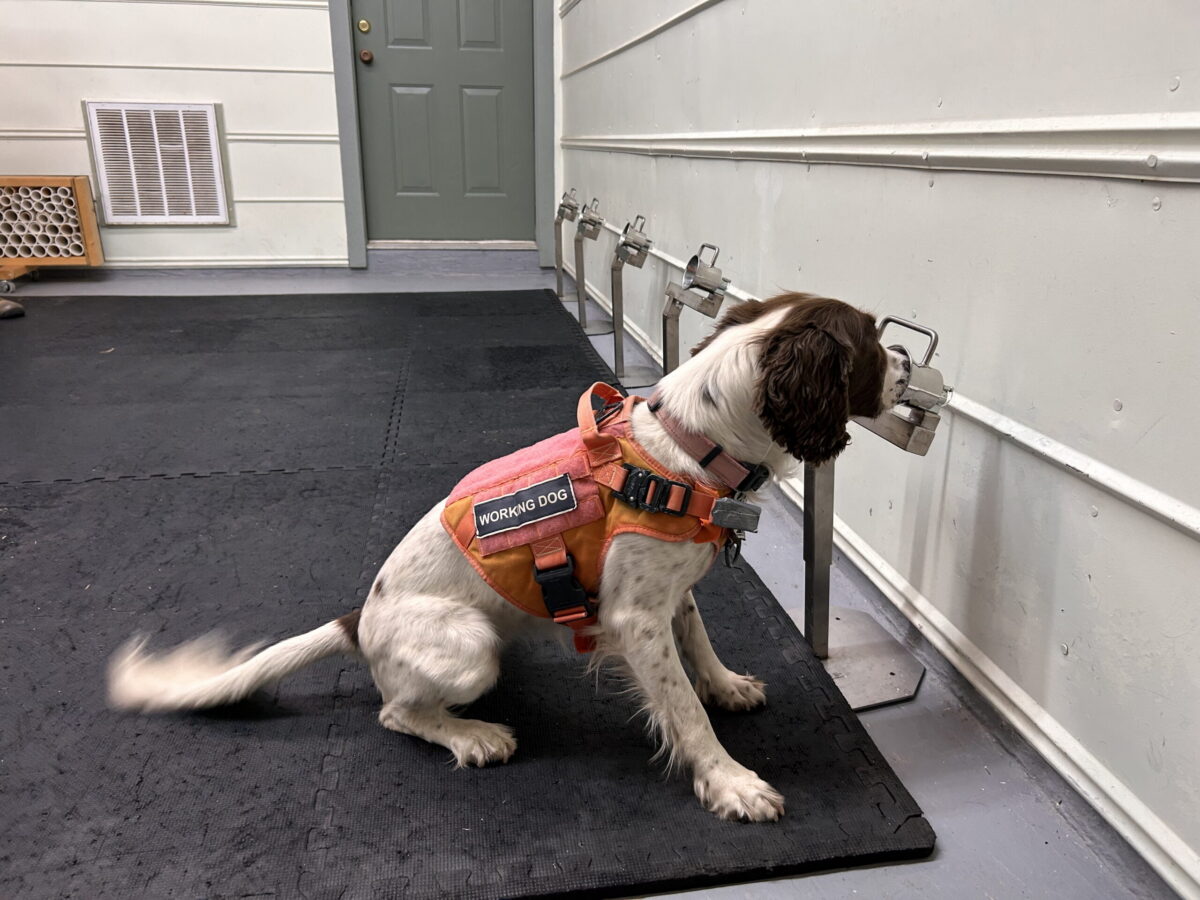
One of the most difficult skills for a detection handler to develop is knowing when to do nothing. When a canine appears uncertain, struggles to access an odor or takes longer than expected to work out a search problem, our instinct is often to step in and help. We may change our position, direct the dog towards the source, repeat a cue or otherwise make the answer easier to find. Although this may produce a successful response in that moment, it can prevent the canine from developing the independent problem-solving skills needed in operational work.

Learning takes place in the process of solving the problem, not simply in reaching the correct answer. When we give a canine time to work through uncertainty, it has an opportunity to gather information, change its search strategy and evaluate the consequences of its choices. The dog may move away and approach from another direction, lift or lower its head, investigate changes in airflow or revisit an area it initially dismissed. These adjustments are valuable. They allow the canine to discover which behaviors lead to the successful location of target odor.

This can be uncomfortable for the handler. Silence and patience may feel like inactivity, particularly when we know exactly where the source is located. However, what looks like a pause or mistake may be the canine processing information. By waiting, observing and resisting the urge to intervene, we give the dog ownership of the search.

Repeatedly solving problems for the canine can create dependency. The dog may begin watching the handler for guidance rather than remaining committed to the odor. Subtle movements, changes in pace, leash pressure and shifts in attention can all become part of the search picture. Over time, the canine may learn that uncertainty should be resolved by asking the handler for assistance rather than by independently investigating the environment.

That dependency may not be obvious during familiar training exercises, especially when the handler knows the location of every source. It becomes far more significant in the field, where the handler may not know whether target odor is present. An operational canine must be able to make independent decisions based on the available odor information, even when the search is difficult and the handler cannot provide an answer.

Allowing the canine to solve problems does not mean leaving it to struggle indefinitely. There is an important difference between productive problem-solving and a training exercise that the dog is not yet equipped to complete. The handler must observe the canine carefully. Is it still actively gathering information and trying different strategies, or has it become frustrated, disengaged or confused? Waiting is useful only while the canine remains capable of learning from the experience.

If the problem cannot be solved by giving the canine more time, avoid guiding it directly to the source simply to manufacture success. Instead, stop the session calmly. Consider why the exercise was unsuccessful and adjust the environment or the training setup. The source may need to be made more accessible, the search area reduced, competing distractions removed or the airflow picture simplified. Once the exercise has been adjusted, reset the canine and rerun the training.

This approach preserves the lesson. The canine still solves the problem, but the problem has been presented at an appropriate level of difficulty. As the dog becomes successful, complexity can be increased gradually. In this way, each repetition builds confidence, resilience and independence without allowing confusion or frustration to dominate the session.

Handlers should also consider whether they are increasing only one element of difficulty at a time. Changing the environment, source height, hide depth, search duration and distraction level simultaneously can make it difficult to identify what caused the canine to struggle. Thoughtful training design enables us to challenge the dog while retaining enough clarity for genuine learning to occur.

Our role as trainers is not to provide every answer. It is to create problems the canine can learn to solve, observe the strategies it uses and adjust the training picture when necessary. Sometimes the most productive thing a handler can do is wait, remain neutral and allow the dog to work.

Give the canine time to think. If it can solve the problem, let it. If it cannot, change the problem—not the answer.

Science Paper Review
La Toya paper

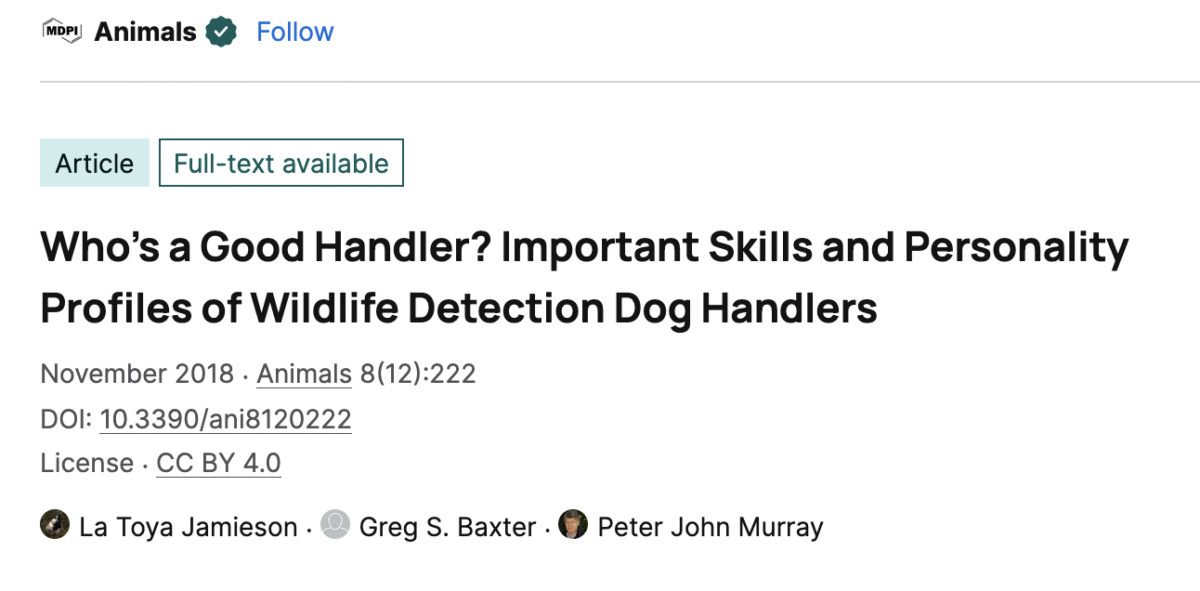
This month’s research review looks at a paper by my friend La Toya Jamieson, together with Greg Baxter and Peter Murray: “Who’s a Good Handler? Important Skills and Personality Profiles of Wildlife Detection Dog Handlers.” The researchers surveyed 35 wildlife detection dog handlers from Australia and New Zealand to explore the skills and personality traits considered important for successful handling.

The ability to read canine body language was rated as the most important skill. This makes sense because handlers must recognize subtle changes in breathing, posture, speed and search patterns long before the canine gives its trained final response. Patience and knowledge of the working environment were also identified as valuable qualities. Interestingly, knowledge of canine olfaction, experience in dog training and report writing received lower ratings, despite their importance in resolving unfamiliar search problems and documenting operational work.

The handlers’ personality profiles varied considerably, suggesting there is no single personality type best suited to detection work. Training, dedication, practical knowledge and the dog–handler relationship may be more influential than whether someone fits a particular personality profile. The paper provides an important reminder that selecting a capable canine is only half of the equation: the dog may possess the nose, but successful detection depends on the team.

Upcoming Events

Looking to advance your skills in detection dog training and handling? Chiron K9 provides tailored mentoring (virtual and in-person), practical workshops, and expert conference presentations worldwide. Whether you’re seeking one-on-one guidance or group learning opportunities, our programs are designed to help you grow with evidence-based practices and real-world experience.

03
September

General Detection & Buried Targets Sydney

- Sydney


11
September

Conservation Canine Workshops

- Queensland


19
September

The Detection of Buried Targets

- South Australia


23
September

Canine Workshops – Perth WA

23-24 September 2026 – All-Clear workshop25-26 September 2026 Problem Solving

- Mt. Helena, Perth


24
October

All-Clear Workshop – UK

- Alderholt Village Hall

Events Page

Thank you for reading this issue of The Chiron Briefing. If you enjoyed it, feel free to share it, forward it, or send me suggestions for future topics. Until next month—train well and take care.

Paul Bunker & the Chiron K9 team


facebook  youtube  instagram 
Unsubscribe   |   Manage your subscription

Somerset, Texas, USA