|
Greetings ,
Welcome to the August Issue of The Chiron Briefing
Welcome to this month’s edition of The Chiron Briefing.
August brings the familiar heat of South Texas, but despite the challenging temperatures, training continues across several exciting projects.
This month, I will travel to Miami to support an OSAC black-box study involving narcotics detection canine teams. I am looking forward to working alongside Dr. Lauryn DeGreeff and her team at Florida International University, as well as Dr. Paola Tildermann and her team from Texas Tech University.
Later in August, I will head to Australia to begin the “Down Under” tour starting in Tasmania—an adventure I am particularly excited about.
Between training and travel, I have also been busy writing another research paper, a chapter to a textbook with an outstanding group of co-authors, and beginning work on a new workbook. I will share more about that project in a future issue.
For now, I hope you enjoy this month’s updates from Chiron K9.
-Paul Bunker and the Chiron K9 team |
| |
Holistic Approach to Detection Canine Training |
| |
|
Chiron K9's Poppy and Nika with a deer |
| |
|
Detection canine training requires a holistic approach. It is not simply putting out target odor, working the team for an hour, and then calling it a day. Odor recognition and search exercises are important, but they represent only one part of developing a reliable and operationally capable canine.
A complete program must consider the whole dog. That includes planned downtime, sufficient sleep and recovery, physical conditioning, strength, endurance, mobility, and maintaining a healthy body weight. Fitness should support the type of operational work the canine will be expected to perform and help reduce fatigue and the risk of injury.
Development also happens away from target odor. Appropriate interaction with other canines can build confidence and improve social stability. Controlled exposure to wildlife teaches the canine to remain composed and work through natural distractions. Exposure to different buildings, vehicles, outdoor areas, weather conditions, surfaces, and unfamiliar environments helps prevent the dog from becoming dependent on one familiar type of location.
Hunt drills and games are equally valuable. They can develop independence, search stamina, problem-solving ability, persistence, and the motivation to continue hunting when odor is difficult to locate or reinforcement is delayed. Play, enrichment, and time to simply be a dog also contribute to emotional balance and long-term enthusiasm for the work.
Odor training builds detection skills, but everything that happens outside the search area helps shape the final operational canine. The goal is not merely a dog that recognizes target odor; it is a healthy, confident, resilient, adaptable, and motivated canine capable of performing reliably in the real world. |
| |
Stainless Steel Tea Leaf Balls |
| |
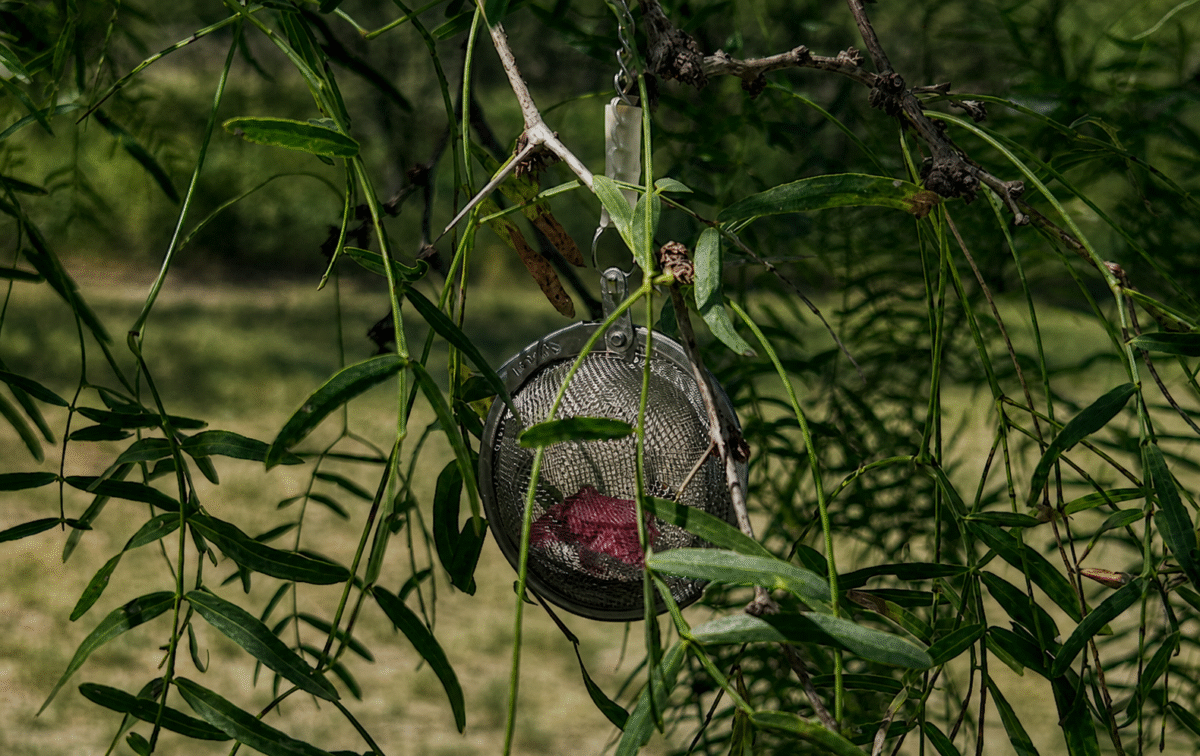
The tea leaf stainless-steel odor balls are a simple and useful addition to an outdoor detection-training kit. Their spherical, ventilated design allows target odor to escape while keeping the training material contained and protected from direct contact with the canine.
These holders are particularly useful for placing odor in trees, bushes, hedges, and other areas of vegetation. They allow trainers to create elevated, suspended, and partially concealed hides that are more realistic than repeatedly placing aids at ground level. Used correctly, they can help teach the canine to follow odor away from the ground, work through vegetation, and identify the source despite wind movement and changing environmental conditions.
The stainless-steel construction is durable, reusable, and relatively easy to clean. The balls can also be secured with cord, wire, or a clip, making them easy to position and recover after training. Their natural metallic appearance blends reasonably well into many outdoor environments without becoming completely invisible to the trainer.
As with any odor container, good handling procedures are essential. Each ball should be clearly assigned to a particular target or control, handled with clean equipment, stored separately, and thoroughly cleaned according to the materials being used. Trainers should also record every placement and confirm that all odor aids have been recovered at the end of the session.
Overall, the tea leaf stainless-steel balls are a practical and versatile option for trainers who want to expand beyond conventional ground-level hides and introduce more challenging outdoor odor problems.
|
| |
|
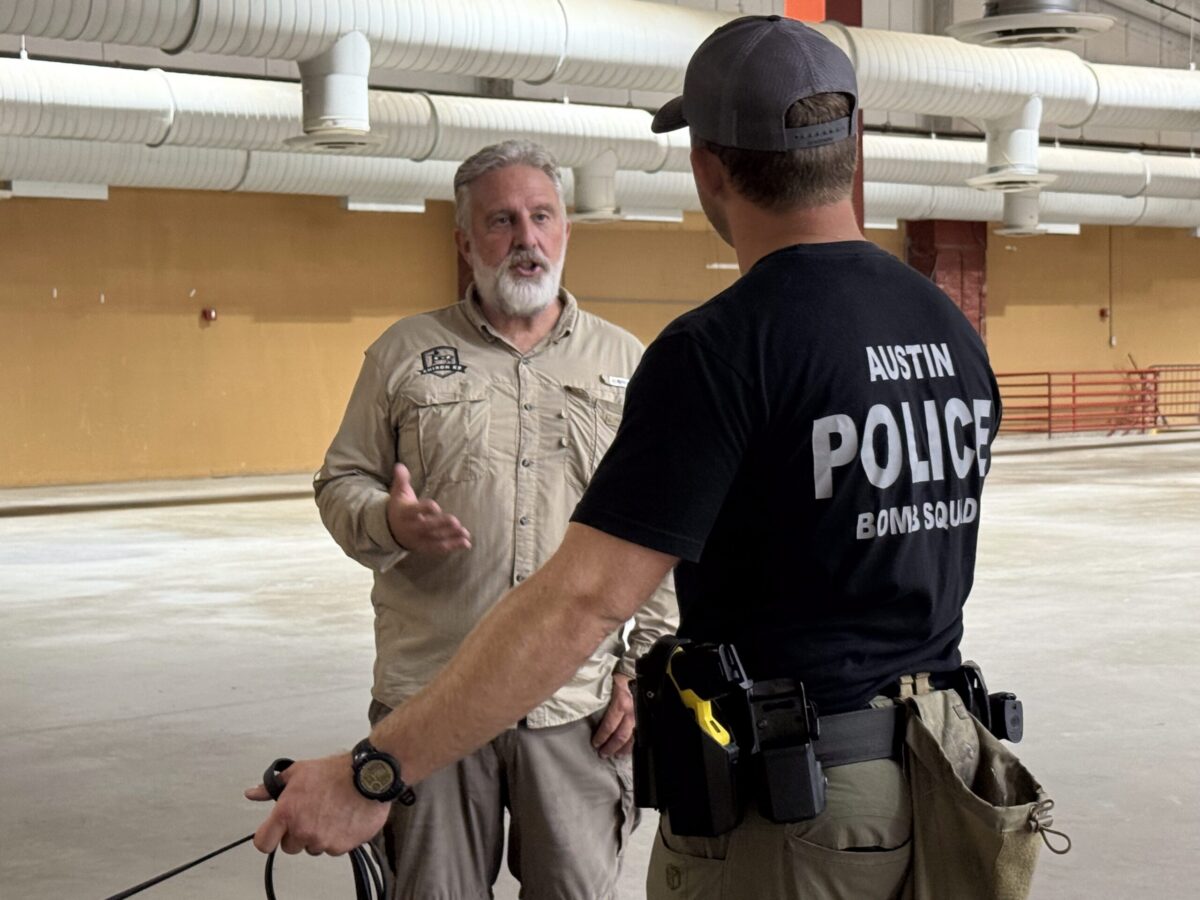
A Law Enforcement canine team at a quarterly multi-agency training event. |
| |
Sharing Training Aids Whenever Possible |
| |
|
Train with other teams that work the same target odors, exchange samples when it is safe and legally permissible, and expose your canine to as much legitimate target variation as possible. A dog that performs well only with your own training aids may not have fully generalized the odor concept required for operational work.
Training aids can acquire distinguishing characteristics from their manufacturer, source, age, storage container, packaging, preparation, handling, transportation, and training location. They may also carry background odors associated with the person who prepared them, the gloves used, a particular container, or the place where they are normally stored. If the same kit is used repeatedly, the canine may learn an unintentionally narrow odor picture or begin responding to these associated odors rather than consistently recognizing the intended target.
Working alongside other teams provides access to different samples, preparation methods, containers, handlers, environments, and operational practices. Whenever possible, use appropriately sourced materials from multiple lots, manufacturers, ages, and storage histories. Have different people prepare and place the aids, vary the packaging and presentation, and train in unfamiliar locations with suitable controls and blanks.
The objective is not for the canine to recognize your training kit. The objective is for the canine to recognize the relevant target-odor concept despite reasonable variation in the sample, the person handling it, its packaging, and the environment in which it is encountered. Generalization must be planned, trained, and tested—it should never be assumed. |
| |
|
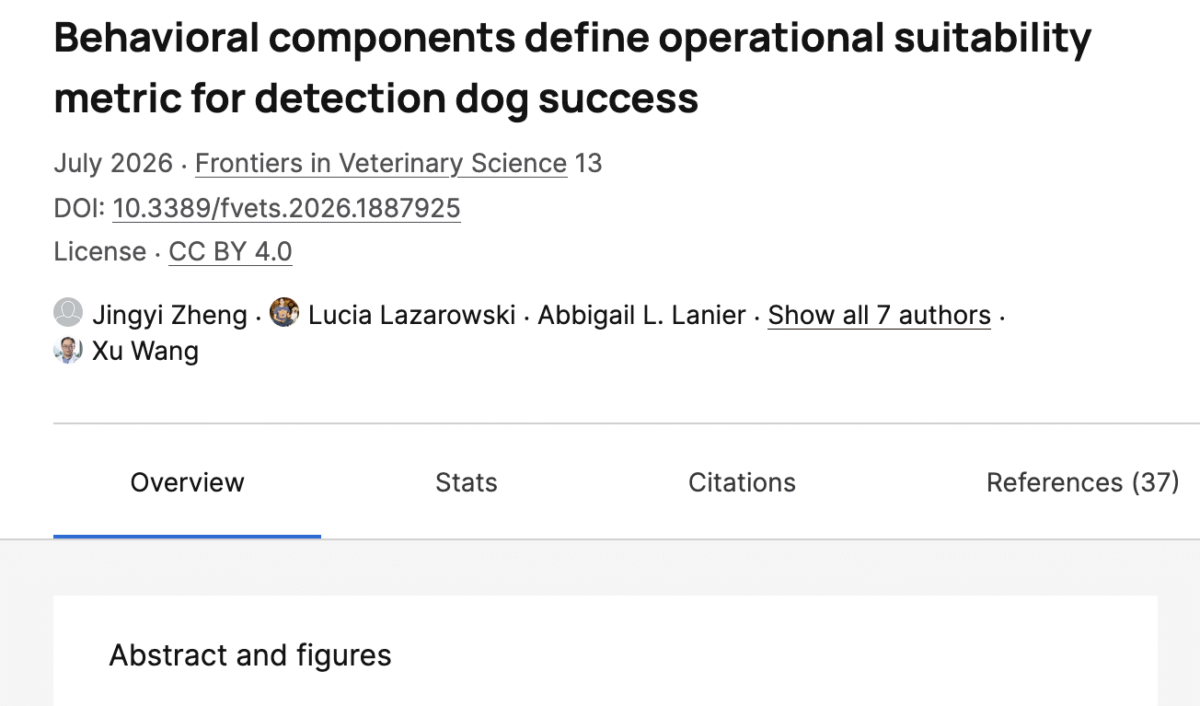
Another interesting paper from our canine olfaction friends at Auburn University.
A recent study, Behavioral Components Define Operational Suitability Metric for Detection Dog Success, examined whether behavioral evaluations can predict which dogs will successfully become operational detection canines.
Researchers analyzed more than 24,000 evaluations from 304 purpose-bred dogs assessed at 3, 6, 10, and 12 months. The assessments measured performance traits—including work effort, hunting, independence, retrieving, and task focus—as well as environmental soundness, such as reactions to people, surfaces, vehicles, urban clutter, and sudden visual or acoustic stimuli. Trainers also assigned each dog an overall operational-suitability score.
The trainers’ suitability score was the strongest individual behavioral predictor of success. At 12 months, it predicted outcomes with approximately 74% accuracy. Assessments conducted at 10 and 12 months were substantially more informative than early puppy evaluations.
The findings also showed that no single trait defines a successful detection dog. Performance characteristics were more influential during early development, while environmental stability became increasingly important as the dogs matured. Dogs that ultimately became operationally capable improved in suitability over time, whereas dogs that washed out showed little or no improvement.
The practical message is that selection decisions should not depend on one test, one desirable trait, or one early assessment. Repeated evaluations of performance, environmental soundness, and developmental progress—combined with experienced trainer judgment—provide a stronger basis for selecting and developing operational detection dogs.
Full Paper HERE |
| |
|
Looking to advance your skills in detection dog training and handling? Chiron K9 provides tailored mentoring (virtual and in-person), practical workshops, and expert conference presentations worldwide. Whether you’re seeking one-on-one guidance or group learning opportunities, our programs are designed to help you grow with evidence-based practices and real-world experience. |
| |
|
Thank you for reading this issue of The Chiron Briefing. If you enjoyed it, feel free to share it, forward it, or send me suggestions for future topics. Until next month—train well and take care.
Paul Bunker & the Chiron K9 team
|
| |
|