|
Greetings ,
Welcome to the July Issue of The Chiron Briefing
Welcome to this month’s edition of The Chiron Briefing.
It continues to be an incredibly busy and rewarding period here at Chiron K9. Our training team is currently focused on preparing detection canines for several exciting projects, including agricultural disease detection, human remains detection, and an ongoing federal research project. It is always a privilege to be involved in work where well-trained detection dogs can make a genuine operational and scientific impact.
This month also sees another Detection of Buried Targets workshop focused on human remains. These workshops have been exceptionally well supported, and it has been encouraging to watch teams develop their skills and confidence as they work through increasingly challenging training scenarios. Thank you to everyone who continues to support these events and invest in developing this important capability.
Behind the scenes, I will finalize the methods paper for the NIST/OSAC Black Box study. This research has been an important collaboration, and I am looking forward to submitting the manuscript for publication this month. Sharing robust, evidence-based methods is essential if we are to continue advancing the detection canine profession.
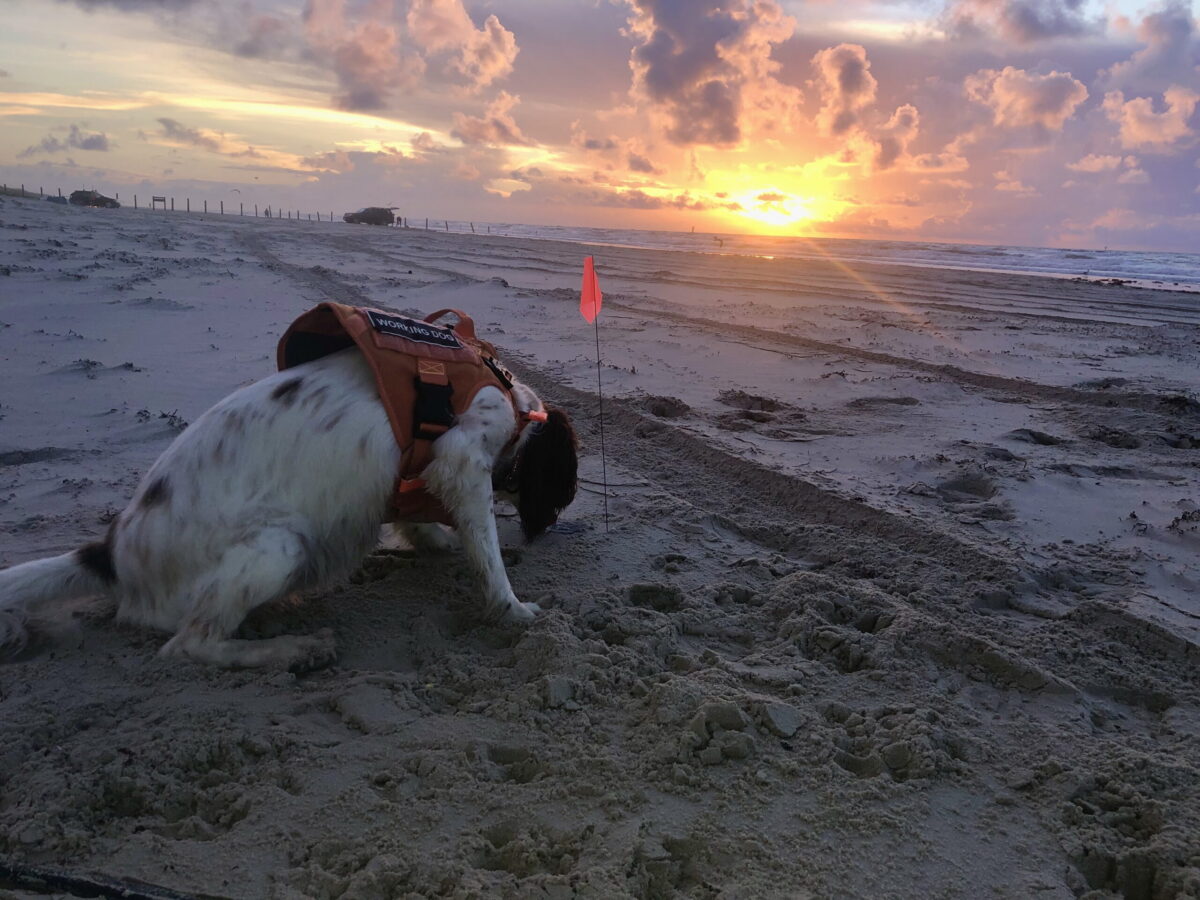
On a more personal note, this month also brought some difficult news. Nika, Chiron K9’s original oil detection canine and, more recently, our remarkable Horned Lizard Detection Canine, underwent emergency surgery to remove a large mass from her colon that was causing significant health problems. Thankfully, she came through the surgery well, but it became clear that it was time for her to retire from operational work.
Nika has given everything throughout her career. From pioneering oil detection research to conservation work protecting one of Texas’ most iconic species, she has consistently demonstrated the extraordinary capabilities of detection dogs. She has represented Chiron K9 with unwavering dedication and has helped shape much of the work we do today.
Retirement is well-deserved. From now on, her days will be filled with comfortable naps, leisurely walks, plenty of treats, and trips to the beach. Our priority is simply to make the rest of her life as happy, comfortable, and enjoyable as possible. Thank you, Nika, for everything you have given us.
As always, thank you for your continued support of Chiron K9 and our mission of Success Through Innovation.
-Paul Bunker and the Chiron K9 team |
| |
Develop the Ability to Hunt |
| |
|
One of the most overlooked aspects of detection dog training is maintaining strong hunt behavior. A dog’s willingness to search, persist, and solve problems is the engine that drives successful detection. Without it, even a dog with excellent odor recognition will struggle during real operational searches.
Hunt should begin long before odor is introduced. Simple games, such as tossing pieces of kibble into long grass, encourage puppies and young dogs to use their nose, stay engaged, and enjoy the process of searching. As they develop, progress to throwing their retrieve toy in increasingly challenging environments such as woodland, brush, or around training areas where they must work independently to locate the reward.
Importantly, hunt development does not stop once a dog is operational. It should be maintained throughout the dog’s entire working life. Regular hunt games, independent searching exercises, and problem-solving scenarios help preserve motivation, persistence, and confidence. These exercises are especially valuable during periods when operational deployments or odor training are less frequent.
A detection dog with strong hunt will push through difficult conditions, work systematically when odor is scarce, and continue searching when the reward is not immediately obvious. |
| |
|
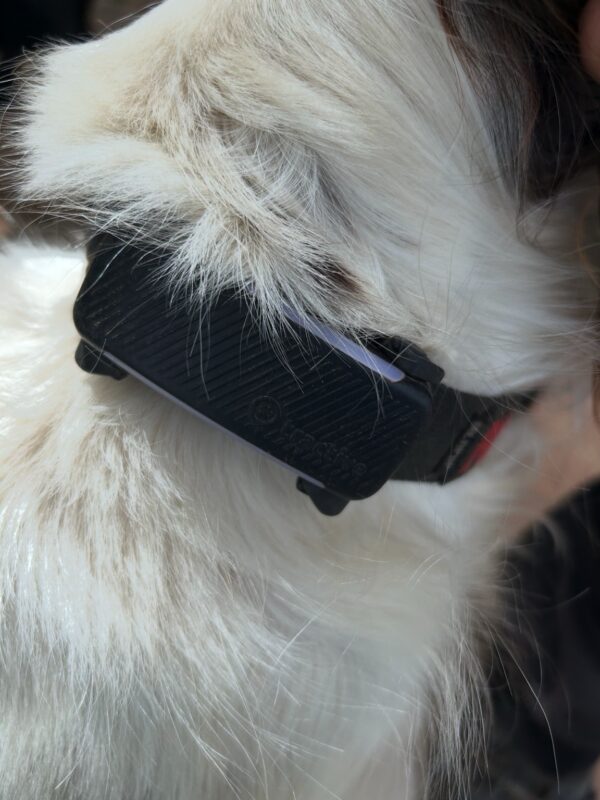
Tractive GPS unit on Poppy's collar |
| |
|
Every one of my dogs—and even my rather well-fed cat (called Fat Cat)—wears a Tractive GPS tracker whenever they are off duty. While I remove them during operational work and training as I use a Garmin Alpha 100 or 300 for duty, they are an invaluable safety net the rest of the time, giving me peace of mind that I can quickly locate them should they ever wander off or become lost.
The GPS tracking is accurate and easy to use through the smartphone app, allowing you to view your animal’s location in real time. One feature I particularly like is the ability to set virtual fences. If one of your animals leaves a designated safe area, you receive an immediate notification, which can be invaluable if a gate is accidentally left open or a curious dog decides to go exploring.
What sets Tractive apart from many GPS trackers is the health monitoring. The device records activity levels, rest, and sleep patterns, allowing you to build a picture of your dog’s normal routine. Changes in activity or sleep can sometimes be an early indicator that something isn’t quite right, helping you identify potential health issues before they become more obvious. While it isn’t a replacement for veterinary care, it provides useful information that can prompt you to investigate changes sooner.
Battery life is generally very good, particularly if you keep the tracker within your home Wi-Fi zone where GPS usage is reduced. Charging is straightforward, and the subscription cost is reasonable considering the features provided.
For working dog handlers, pet owners, and anyone who values the safety of their animals, I think the Tractive tracker is an excellent investment. It provides reassurance if an animal goes missing while also giving useful insights into their daily health and well-being. Hopefully you’ll never need to use the GPS to recover a lost dog—but if that day ever comes, you’ll be very glad it’s on the collar.
https://tractive.com/
|
| |
Joint Symposium for Working K9s |
| |
|
If you’re serious about advancing your knowledge of working dogs, I cannot recommend the Joint Symposium for Working K9s (JSWK9) highly enough. Bringing together researchers, trainers, handlers, and operational professionals from across the working dog disciplines, it is, in my opinion, the best canine conference I have ever attended.
The conference is jointly hosted by leading organizations including the Penn Vet Working Dog Center, Auburn University, Florida International University, Texas Tech University, and K9SciCon, creating a unique opportunity to bridge science and operational practice.
I’m delighted to announce that Chiron K9 will once again be attending with a vendor booth, so please stop by and say hello. We’ll have books, training resources, and there may even be some very exciting news involving Chiron K9 and myself that I can’t quite reveal just yet!
Christina is planning to deliver a Predation Substitution workshop at the conference, sharing practical techniques to benefit trainers and handlers working across a range of disciplines.
Whether your passion is detection, conservation, search and rescue, police, military, sporting dogs, or canine research, JSWK9 offers an outstanding opportunity to learn from world-class speakers, build new relationships, and be part of a community committed to improving the future of working dogs.
I hope to see many of you there!
For more information and conference updates, visit https://www.jswk9.com/ |
| |
|
This paper addresses an important operational question for oil spill response: can trained detection dogs distinguish between different types and ages of petroleum products rather than simply responding to “oil”?
The study evaluated canines' ability to distinguish weathered (old) from unweathered (fresh) oil in a shoreline environment.
The results demonstrated that the dogs reliably differentiated between closely related oil products with high accuracy, highlighting the remarkable specificity of canine olfaction.
One of the key findings is that detection dogs are not simply identifying a generic “oil” odor. Instead, with appropriate training, they can learn odor profiles associated with specific oil products, even after weathering has altered their chemical composition. This has significant implications for environmental response operations where identifying the correct contaminant influences cleanup strategies and environmental assessments.
The study also reinforces several important training principles. Accurate discrimination depends on careful odor selection, systematic progression during training, rigorous quality control, and double-blind validation. These findings support the growing body of evidence that detection dogs should be viewed as highly precise biological sensors whose performance is directly influenced by the quality of their training program rather than simply their natural ability.
For trainers, the paper provides an excellent example of how structured discrimination training can yield highly specific odor recognition while minimizing false alarms. For environmental professionals, it demonstrates another practical application where detection dogs can provide rapid, non-invasive, and highly sensitive support during oil spill response and monitoring operations.
Overall, this paper is another step forward in demonstrating that well-trained detection dogs can move beyond simple target recognition and perform sophisticated odor discrimination tasks that would be difficult, time-consuming, or expensive to achieve using conventional methods alone.
Full Paper HERE |
| |
|
Looking to advance your skills in detection dog training and handling? Chiron K9 provides tailored mentoring (virtual and in-person), practical workshops, and expert conference presentations worldwide. Whether you’re seeking one-on-one guidance or group learning opportunities, our programs are designed to help you grow with evidence-based practices and real-world experience. |
| |
|
Thank you for reading this issue of The Chiron Briefing. If you enjoyed it, feel free to share it, forward it, or send me suggestions for future topics. Until next month—train well and take care.
Paul Bunker & the Chiron K9 team
|
| |
|