|
Greetings ,
Welcome to the May Issue of The Chiron Briefing
April was a strong month for Chiron K9, including an outstanding weekend that hosted the Science of Odor workshop with Dr. Lauryn DeGreeff. The seminar covered key areas, including the generalization, handling, and storage of training aids, odor movement, environmental factors, and more. It was a great opportunity to step back, review the science, and connect it directly to practical applications in detection training. I also was hosted by Carter's Pet Services for a Detection of Buried Targets workshop held at a great venue in the beautiful English countryside. Beautiful weather ensured the workshop went very well and the attendees and canines with away with more tools in the tool bag!
May is shaping up to be just as busy. I’ll be back in the UK delivering workshops, including The All-Clear and Detection of Buried Targets. I’ll also be heading to Utah to deliver presentations and working sessions for the National Search Dog Alliance seminar, which I’m looking forward to.
Back in Texas, I’ll be hosting a Human Remains buried targets workshop, with plans to run more of these going forward. We’ll also be attending the Texas Environmental Trade Fair and Conference (ETFC) as a vendor, continuing to push the role of detection canines in environmental applications.
On the education side, I’ve launched the subscription membership level for The Detection Dog Lab on Skool. Throughout May, I’ll be running live calls and coffee sessions and adding more premium content to the classroom.
Alongside all of this, training continues—as always.
-Paul Bunker and the Chiron K9 team |
| |
Lineups - They are the Marmite of the Canine world* |
| |
|
For some people, lineups are necessary. For others, they are something to avoid.
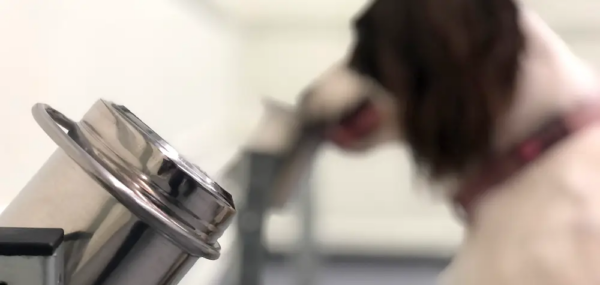
Avoiding lineups is often where problems begin. In this context, I am talking about a line of pots, cans, stands, Mason jars, and similar items.
Lineups can be challenging. Some canines find them boring, stifling their hunt desires, repetitive, and restrictive.
I see the same “issues” with lineups during workshops all around the world:
- Skipping item number 1
- Responding to the last item when no target is present
- Detecting the target but not responding, and searching all items before returning to the target to respond.
- Licking the container with the target
Lineups require training and an understanding of why these issues occur and why canines struggle to master the protocol.
Too often, teams focus on search environments such as rooms, vehicles, and other areas, but they rarely test the dog’s understanding of lineups. This can result in a dog that appears skilled in the field but fails an Odor Recognition Test (ORT).
Lineups allow you to:
- Assess true odor recognition.
- Build discrimination between target and non-target
- Develop consistent final responses.
- Control variables and reduce contamination
- Collect meaningful data on performance.
- Introduce new target odors in a controlled way
- Manipulate thresholds
- And much more
But they also demand discipline from the handler.
Lineups are not just about “finding the hide.” They help build a dog that truly understands its job. This means a dog that can work with faint odors, ignore distractions, and commit with confidence.
If you avoid lineups, you are not avoiding difficulty. You are avoiding clarity.
And without clarity, you’re guessing.
When used correctly, lineups are a powerful tool in your training. They are not easy, but they are honest.
I will be posting a class about training Lineups in my Skool classroom in the future.
* For non-British readers, Marmite is a yeast extract spread used in the UK, typically on toast, and has a very unique taste. The sales slogan is "Love it or hate it" and in the UK the term Marmite is used for something that people either love or hate. |
| |
Training Aid Delivery Device (TADD) |
| |
|
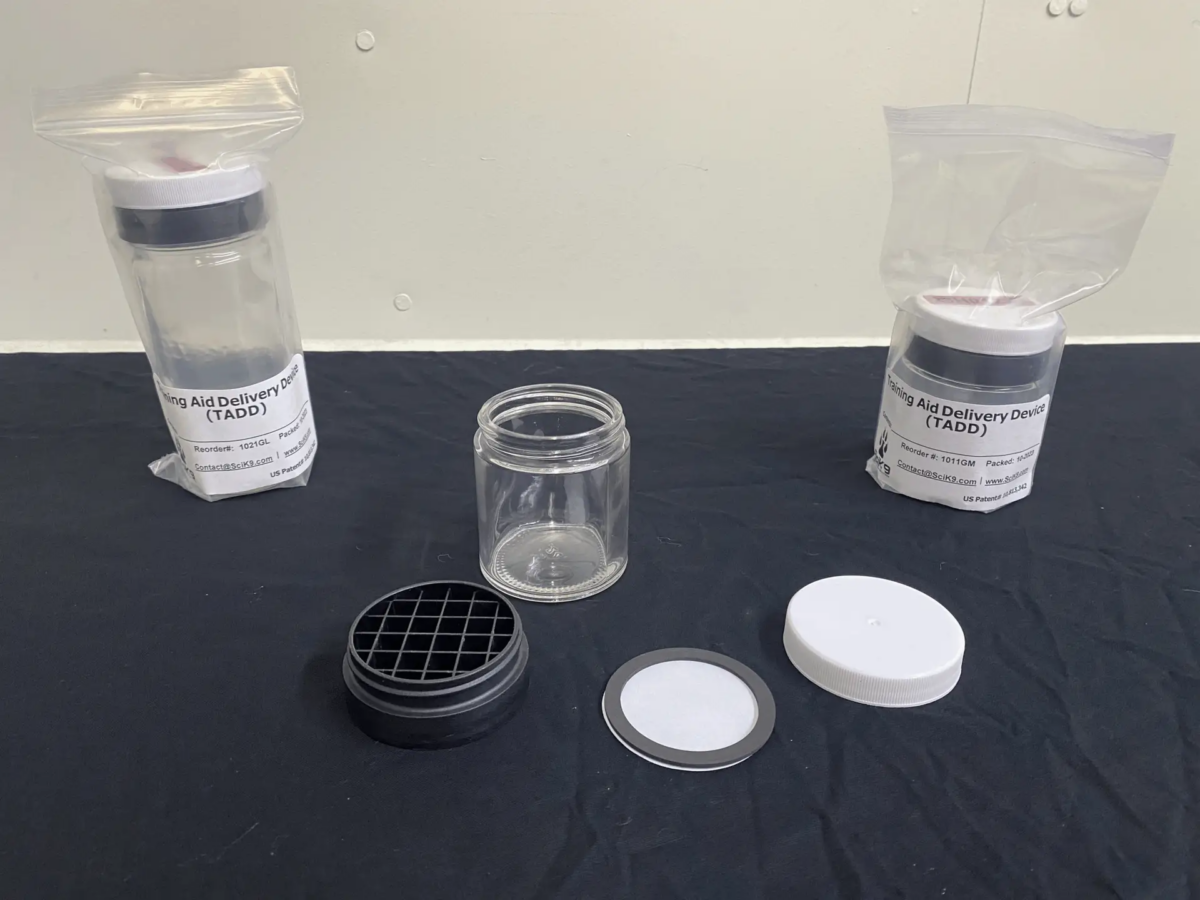
Training Aid Delivery Devices (TADDs) have become central to how I run controlled detection training.
I rely on them for both buried target and underwater detection training. In these settings, it’s important to control the odor picture. You need consistency, containment, and a way to present odor without contaminating the area.
That’s what a TADD does.
It provides a controlled way to deliver odor, reduces environmental impact, and maintains consistent training sessions. This matters most when you’re working with low thresholds or learning how odor moves in places like soil or water.
A common mistake I see is people buying one TADD and thinking that’s all they need.
To use TADDs properly, you should have at least three:
- One for the target odor
- One for a distractor
- One as a control (blank)
Without all three, you’re not really testing discrimination. You’re just reinforcing presence. The control lets you confirm that the dog is not responding to the device itself. The distractor allows you to challenge the dog’s decision-making. The target confirms recognition.
That combination is what makes TADDs valuable.
TADDs aren’t just containers. They help you add structure, prevent contamination, and make your training clearer. However, just like ant other training tool, you need to understand the capabilities and limitations and develop your training plan accordingly.
Website |
| |
Human Remains Certification Standard |
| |
|
ANSI/ASB Standard 076: A Step Forward for Human Remains Detection
The release of ANSI/ASB Standard 076 – Standard for Training and Certification of Canine Detection of Human Remains: Human Remains on Land (First Edition, 2026) marks an important step forward for the discipline.
Developed through the ASB Consensus Body on Dogs and Sensors, this standard provides a structured, evidence-based framework for the training and certification of Human Remains Detection (HRD) canine teams.
For a field that has historically varied widely in approach, this introduces something that has been needed for a long time—standardization.
The standard outlines expectations for:
- Training processes
- Operational performance
- Certification requirements
It moves the conversation away from opinion and toward defined criteria.
That matters.
Because consistency in training leads to reliability in the field. And reliability is what underpins credibility—whether that’s in operational deployment or within the legal system.
Standards like this are not about restricting training—they are about raising it.
For those serious about Human Remains Detection, this is an opportunity:
- To align training with recognized best practice
- To validate capability against a defined standard
- To contribute to the continued development of the field
At Chiron K9, as an implementer of OSAC-aligned standards, this provides a clear framework to support training and certification moving forward.
This is not the end point—it’s a foundation.
And what is done with it will determine the next stage of development for HRD canine work.
Link to the standard HERE |
| |
|
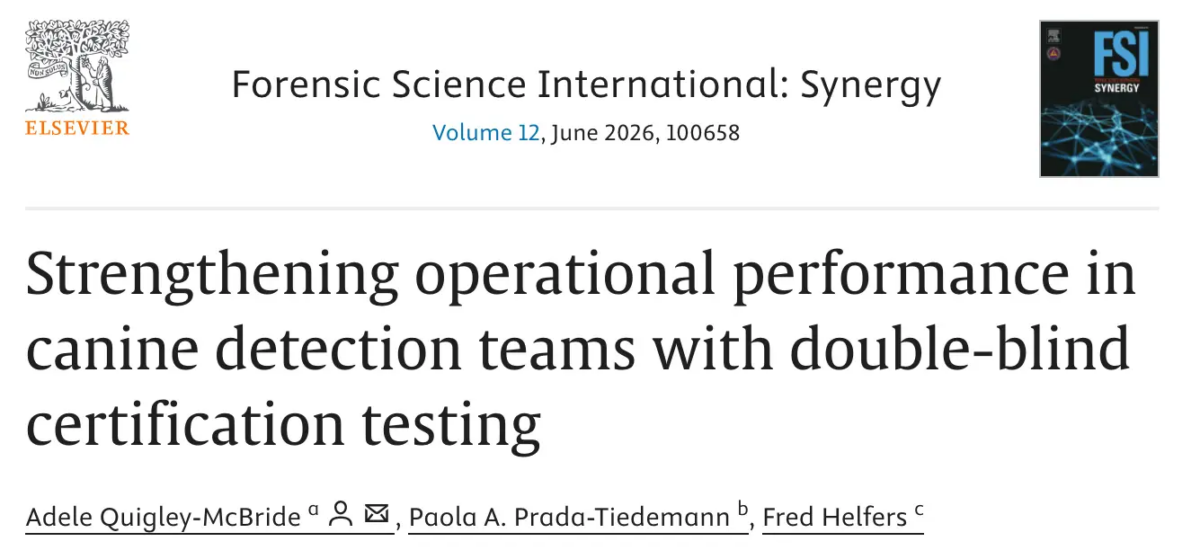
This paper examines how professional canine-handler teams perform in certification trials, especially comparing single-blind and double-blind testing.
After reviewing years of data from hundreds of trials, the study shows that performance depends not only on the dog’s skill but also on testing conditions, handler expectations, and how training is set up.
A key finding is the effect of blind testing. When handlers do not know where or if the target odor is present, the results show the dog’s real ability. This supports the ongoing concern in detection work that handler influence can unintentionally affect outcomes.
The study also finds that team performance varies, showing that passing certification does not always mean a team will perform reliably in real situations. In other words, passing a test does not guarantee the team will do well in all conditions.
Detection ability is not only about the dog. It also depends on the whole system, including training design, testing setup, and how performance is measured.
For trainers and handlers, this shows the need to:
- Incorporate double-blind training and testing
- Reduce handler bias
- Focus on repeatable, evidence-based performance
- Move beyond “pass/fail” thinking and toward true capability
This paper demonstrates that if you want to truly understand your dog’s abilities, you need to set aside your own assumptions.
Paper HERE |
| |
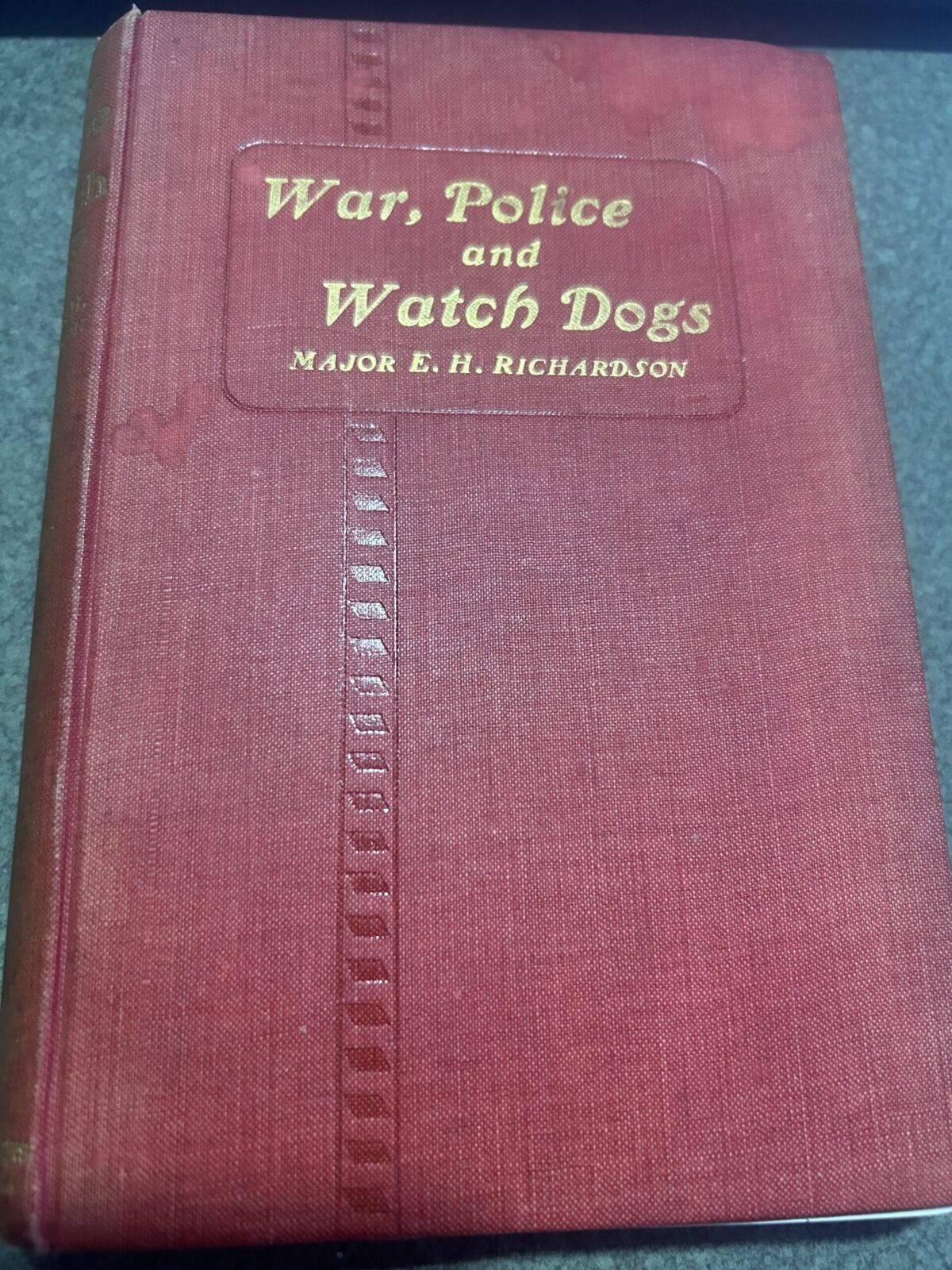
War, Police and Watch Dogs by Major EH Richardson
|
| |
|
Published in 1910!
This is one of those older texts that still has value if you take the time to read it properly.
I have the full collection of Major Richardson’s books, and despite their age, there are still relevant points for canine training today. The context may be different, but the fundamentals—understanding the dog, developing reliability, and building working capability—haven’t changed.
What stands out is the focus on practicality. These weren’t written as theory-heavy texts—they were written from real-world application, and you can see that in the way training and use of dogs is described.
Specifically, in this book, his summary includes the following statement:
"From all that I have said, it will be clear that the handler of dogs must, in order to be expert, thoroughly understand, as far as possible, this mysterious agency of scent, which is an element quite outside any power of the dog; and where the poor beast might be blamed by an ignoramus for bad work, that in fact might be that it was being asked to do an impossibility, and that no trail remains for it to follow."
He continues:
" Only the novice, or one who has had merely elementary experience, does so, while the man who has perhaps spent his life investigating the subject knows that he has still much to learn."
I think I would have enjoyed meeting Lt. Col. Richardson!
First reviewed in my Skool community.
|
| |
|
Looking to advance your skills in detection dog training and handling? Chiron K9 provides tailored mentoring (virtual and in-person), practical workshops, and expert conference presentations worldwide. Whether you’re seeking one-on-one guidance or group learning opportunities, our programs are designed to help you grow with evidence-based practices and real-world experience. |
| |
|
Thank you for reading this issue of The Chiron Briefing. If you enjoyed it, feel free to share it, forward it, or send me suggestions for future topics. Until next month—train well and take care.
Paul Bunker & the Chiron K9 team
|
| |
|