|
Greetings ,
Welcome to the February Issue of The Chiron Briefing
February is shaping up to be a busy and rewarding month, with work spanning training, mentoring, and research on both sides of the Atlantic. I’ll be in the UK conducting a detection canine workshop, followed by mentoring at a three-day conservation detection conference in Devon—an opportunity I’m very much looking forward to, particularly for the discussions around real-world application, problem solving, and evidence-based practice in conservation canine work.
From there, I’ll be heading to Miami to support a follow-up research trial examining the NIST OSAC Explosive Detection Canine certification standards, building on last year’s published research. Continuing this work is critical for validating testing frameworks, refining methodology, and ensuring that certification standards genuinely reflect operational performance rather than training artifacts.
I’m also pleased to share that my new workbook, The Detection of Buried Targets by Canines: Methods, Skills & Training Protocols, is complete and ready for publication. I hope to get it published this weekend. This project brings together field experience, research insight, and structured training protocols to address one of the most misunderstood and operationally challenging areas of detection work.
My Skool community, The Detection Dog Lab, continues to grow, and I appreciate everyone who has joined.
The Detection Dog Lab - Join Here
As always, this newsletter is about sharing what I’m learning along the way—what works, what needs questioning, and how we continue to move detection canine training forward with clarity, integrity, and curiosity.
-Paul Bunker and the Chiron K9 team
|
| |
Neutralize Containers Early |
| |
|
Containers should be invisible in detection training.
A long time ago (1999), I encountered an issue: canines could detect 0.025g of TNT melted onto a piece of filter paper, but not TNT on the paper. I realized that the canines were using the paper's odor as their primary cue and then discriminating whether the paper contained TNT. They would ignore the non-TNT filter papers and respond only to those with TNT. Initially, I thought training was going well until we removed the filter paper from the TNT and then saw the issue. This meant the container (filter paper) had become the primary odor, and that was a training issue.
If a dog is searching for objects rather than odor, the training system has unintentionally trained value to the container rather than the scent it holds. Early in training, containers are often repeatedly paired with target odor and reward, which can be helpful during imprinting but carries a risk. Dogs are exceptionally good at forming associations, and when reinforcement consistently follows a particular container, the container itself can become a conditioned predictor of reward. When this happens, the canine may begin to pattern-match shape, material, placement, or novelty rather than committing to accurate odor recognition.
This is especially important when dealing with low-volatility or trace amounts of the target odor.
This issue often presents as confident performance in familiar setups but hesitation, errors, or false alerts when containers change or are removed. In operational or field environments, this can reduce accuracy and reliability. Containers are merely a teaching tool designed to hold odor, not the target itself. When a container holds value, the dog is responding to the wrong information. To correct this, the container value must be neutralized by rotating container types and placements and reinforcing only when odor is present. Simplifying the picture and occasionally removing containers altogether helps reestablish the rule that odor—not objects—drives the search.
The simplest test is to ask whether the canine would still locate the target if the container were removed. If the answer is no, the container has become too meaningful. The solution is not additional pressure or tighter criteria, but rebuilding the association that odor matters, not objects. Getting this right early leads to cleaner training, clearer odor communication, and more reliable detection performance. |
| |
Why We Choose the Non‑Stop Dogwear Protector (Snow) |
| |
|
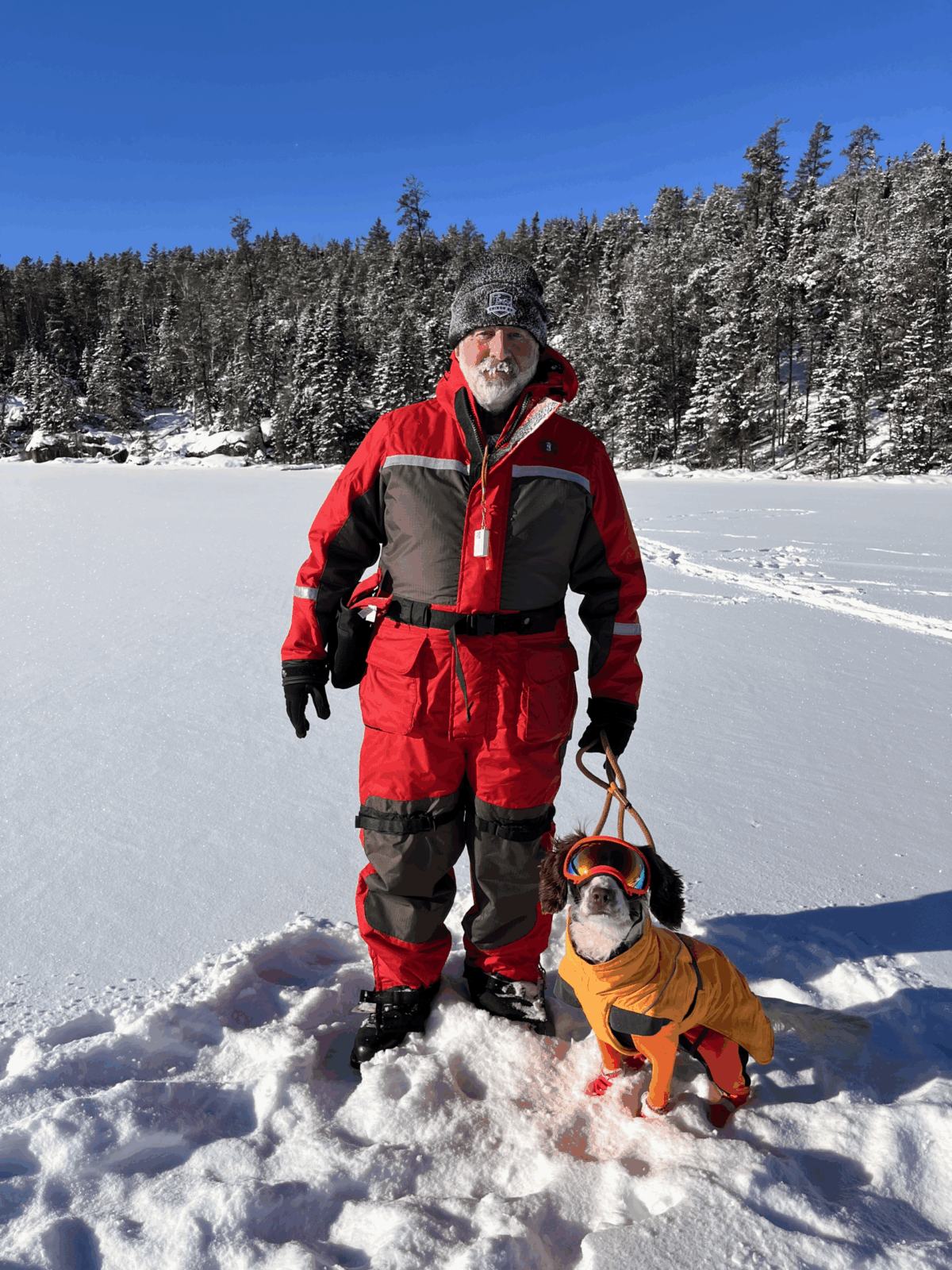
Last year, I had the chance to put the Non‑Stop Dogwear Protector (Snow) to the test on a field trial in Canada in snow and temperatures down to –12 °F (about –24 °C), and it performed exceptionally well.
This full-body snow suit is designed to protect a dog’s coat from snow, ice, cold, and wind while still allowing complete freedom of movement thanks to its elastic, form-fitting construction. The bright orange with reflective accents also made Poppy highly visible in low-light and heavy snow conditions, which was a real bonus out in the field. It comes in male and female versions and works perfectly for both when they need to toilet.
What stood out most was how well it kept snow from clumping in her fur, helping her stay comfortable and focused throughout long search sessions. I paired it with an appropriate insulating jacket and booties, and it worked beautifully even in deep snow.
The suit didn’t restrict her movement, and once we got used to putting it on, it became a dependable part of our cold-weather kit. For anyone working with dogs in snowy, sub-freezing conditions, this is a well-designed, practical option that balances protection and mobility.
HERE |
| |
|
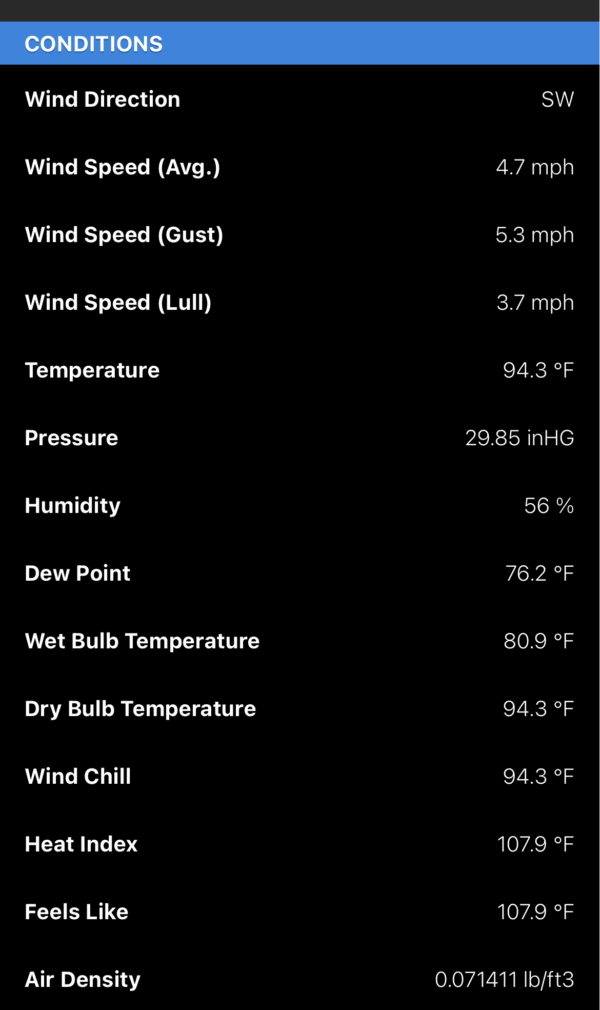
Example of the information collected by the Tempest WeatherMeter (from one of my surveys) |
| |
|
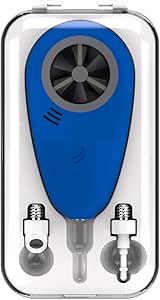
Understanding environmental conditions is critical for detection work, and recording climatic conditions in survey and training reports is critical for longer-term data analysis. For that reason, the Tempest WeatherMeter has become a reliable tool in my deployment bag. I’ve used it across a wide range of conditions—from the extreme heat of Texas to sub-zero (32°F / 0°C) temperatures in Canada—and it has consistently performed well.
One of the strengths of the Tempest WeatherMeter is its reliable connectivity to a phone or tablet, allowing climatic data to be captured, stored, and reviewed easily. This makes it particularly useful for training documentation, research projects, and post-search analysis, where environmental context matters as much as the search outcome itself.
It’s important to note that the Tempest is not an instant-read device. For accurate data, it needs to be placed in the environment and allowed time to acclimate and stabilize. Once adjusted, however, it provides dependable readings that help inform training decisions and support more robust records.
Overall, it’s a practical, field-ready tool that supports better understanding of how temperature, wind, and other conditions influence odor and canine performance—and one I’ve been happy to rely on in both training and operational environments. |
| |
Strengthening operational performance in canine detection teams with double-blind certification testing
|
| |
|
This paper reinforces something I have seen repeatedly in operational training and fieldwork: detection dogs can perform exceptionally well, yet performance can change significantly depending on how we train as handlers and trainers.
This paper describes how, under single-blind conditions—where someone involved knows the target locations—pass rates were high. When teams were moved into double-blind scenarios, performance dropped. To me, this doesn’t indicate that the dogs suddenly “forgot” how to detect odor; it highlights how much human expectation, pattern recognition, and subtle influence can affect outcomes.
That is exactly why I deliberately use both single-blind and double-blind training—not just to train the dog, but to train myself and the handler as well. Single-blind setups are valuable for building confidence, shaping behavior, and developing skills. Double-blind work removes safety nets. It forces honesty, exposes gaps in handling, and ensures the dog is making independent decisions based solely on odor. When teams improve after repeated double-blind exposure, as shown in this study, it confirms that these skills are trainable—not mysterious or out of reach.
For me, double-blind training isn’t about making things harder for the sake of it; it’s about building credibility, resilience, and trust in both the canine and the handler when the stakes are real and the answers are unknown. That’s where operational reliability lives—and why we continue to use both methods as part of a complete, defensible detection training program.
After all, shouldn't we train like real-life deployments.....how often do you know where your target is before a search?
Read the paper HERE |
| |
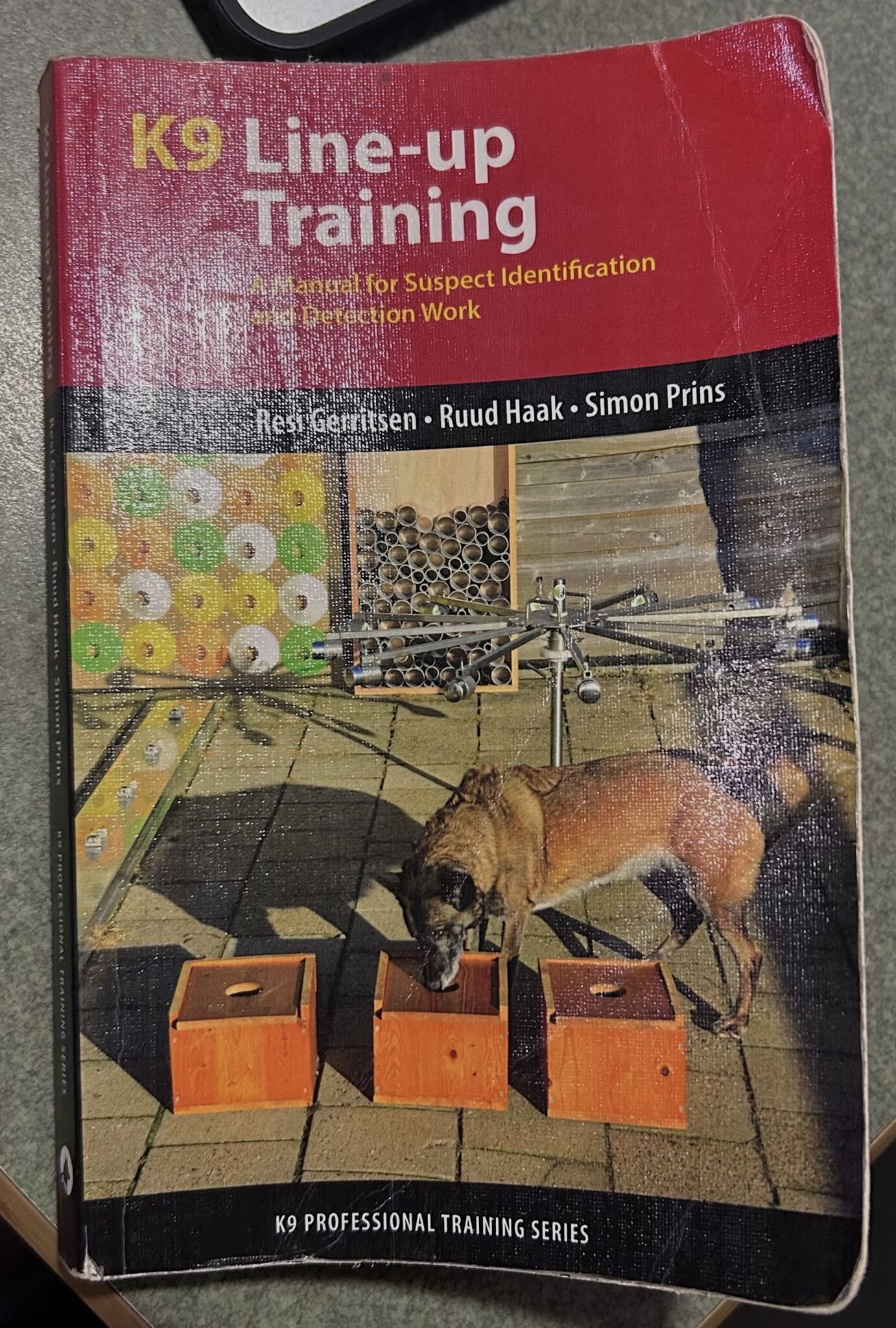
K9 Line-Up Training – A Manual for Suspect Identification and Detection Work
|
| |
|
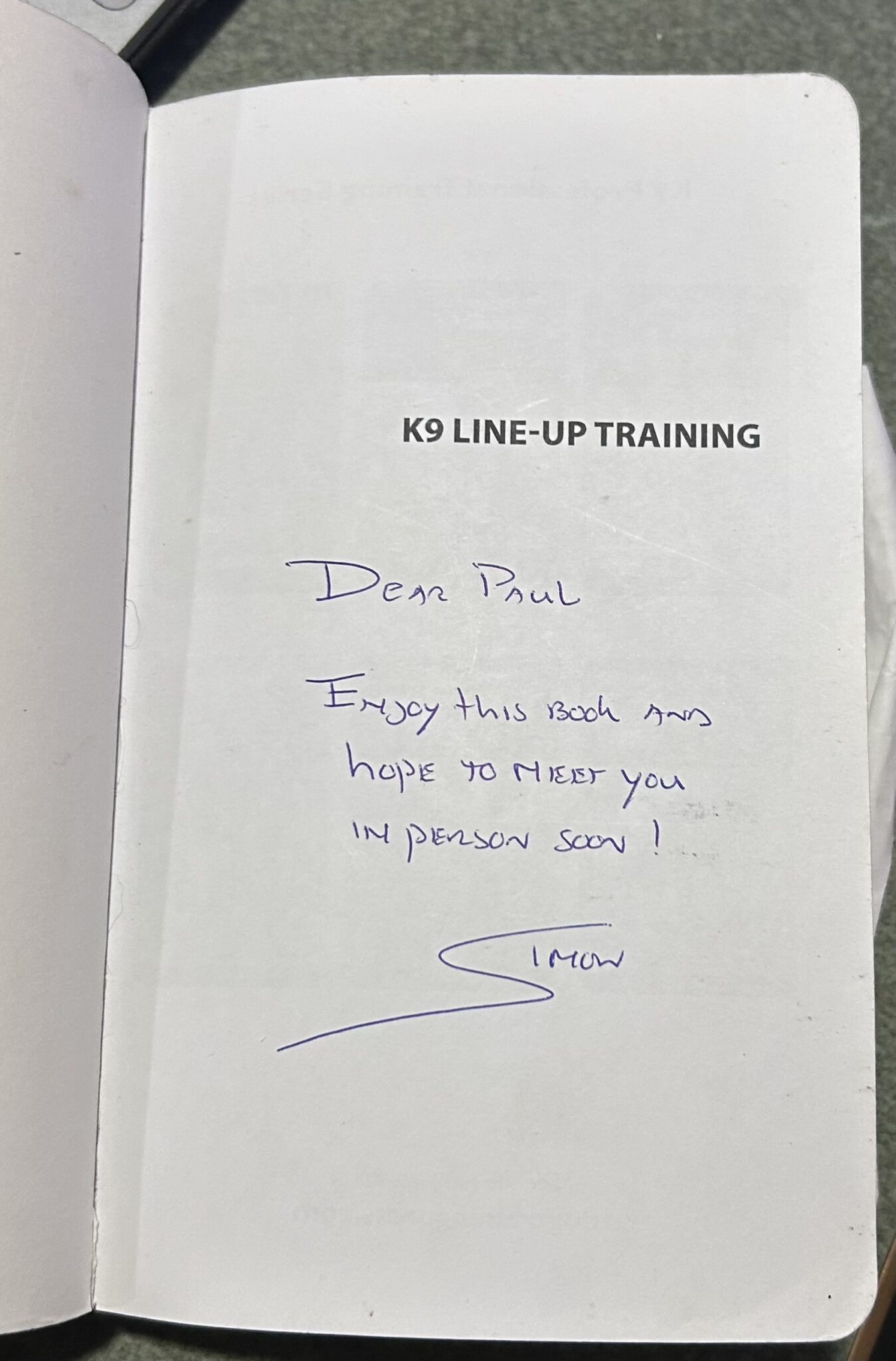
My well-thumbed and signed copy of the book |
| |
|
One of the most persistent challenges I see when working with detection teams—across disciplines, experience levels, and agencies—is effective performance in line-ups. Whether at workshops, assessments, or refresher training, line-ups are often where otherwise solid teams struggle the most. That’s why K9 Line-Up Training: A Manual for Suspect Identification and Detection Work is such a valuable resource.
Written by a team of highly respected and experienced trainers, Resi Gerritsen, Ruud Haak, and Simon Prins, they break down the history, training, and utilization of line-ups. While the book does discuss Suspect Identification, which may not be relevant to everyone, it does go into detail about line-ups for general detection.
Often, in our research projects, we are required to conduct lineup-style trials to collect data. That could be a line of stands, boxes, olfactometers, odor wheel, or containers, and in each case, the data is only as robust as the training put into the canine. We use methods such as variable-reward type, variable-reward schedule, and the All-Clear to ensure our canines have the tools to search a line-up of any type efficiently, effectively, and robustly.
Line-ups—sometimes referred to as Odor Recognition Tests (ORTs), odor validation, cans, or similar terms, depending on discipline and geography—are not a “simple” task or a box-ticking exercise. They are a distinct search systemthat requires its own structured training, clear criteria, and thoughtful progression. Too often, line-ups are treated as something dogs should just “know” how to do once they are trained on odor. In reality, they demand as much—if not more—training than many operational search systems.
What this manual does well is break line-ups down into atrainable skill, rather than presenting them as a pass/fail test of the dog. It addresses the mechanics, handler influence, setup variables, and common pitfalls that undermine performance. Importantly, it reinforces that poor line-up performance is rarely a “dog problem”—it is usually atraining and system design problem.
From my perspective, line-ups are one of the clearest examples of why clarity, consistency, and repetition matter in detection work. They require precise odor discrimination, emotional control, and clean decision-making from the canine, all while the handler must remain neutral and disciplined. Those skills do not appear by accident—they are built deliberately.
The encouraging message in this book, and one I strongly agree with, is thatline-ups are not impossible to master. They are absolutely achievable with correct training, structured exposure, and realistic expectations. When teams invest the same effort into line-ups as they do into area searches, vehicles, rooms, or field work, performance improves dramatically.
For trainers, handlers, and program managers who want to strengthen reliability, reduce errors, and improve confidence in odor discrimination work, this manual is well worth the read. Line-ups are not an afterthought—they are a core skill, and this book treats them accordingly.
|
| |
|
Looking to advance your skills in detection dog training and handling? Chiron K9 provides tailored mentoring (virtual and in-person), practical workshops, and expert conference presentations worldwide. Whether you’re seeking one-on-one guidance or group learning opportunities, our programs are designed to help you grow with evidence-based practices and real-world experience. |
| |
|
Thank you for reading this issue of The Chiron Briefing. If you enjoyed it, feel free to share it, forward it, or send me suggestions for future topics. Until next month—train well and take care.
Paul Bunker & the Chiron K9 team
|
| |
|